

- The 70% change failure rate has no source, but change management still pays. A 2011 review found no evidence behind the famous figure. What the evidence does show is that well-run change management goes with far better project results, and that teams following a structured method run it better.
- The change curve is a vocabulary, not a forecast. It helps a team expect a dip in performance, but it assumes everyone moves through the same stages and recovers, and it can turn a valid objection into "denial".
- Stability is a condition of good work. People do their best when work is predictable, they have some control, relationships and routines hold, and the purpose is clear. A typical reorganization disturbs nearly all of it.
- The bigger problem is volume, not resistance. The average employee faced 10 planned enterprise changes in 2022, up from 2 in 2016, and often no one owns the total.
- Five practices hold change and stability together. Name what isn't changing, publish the order, finish things visibly, protect working teams, and let the people affected shape the rollout.
- In Kenya, much of the change isn't chosen. Levies, pension and health insurance contributions, and the exchange rate shift on someone else's timetable, which makes the stability a leader can protect worth more.
Change management is the work of getting people to adopt a decision, not just hear it. It covers how a change is planned, explained, trained and reinforced until the new way of working becomes the normal one. Stability is its quieter counterpart: the predictable routines, steady relationships and clear purpose that let people do good work while things around them move. Most organizations budget carefully for the first and treat the second as the thing they are leaving behind.
The complaint we hear most from executives in our East African leadership programs is that their people resist change. Managers and staff one layer down describe something else: earlier initiatives, a new system here and a restructure there, were launched and then left half done, and nobody has said which of the current ones matters most. The first complaint is about resistance, people pushing back against a change. The second is about overload: too many open changes and no stated priority. Only the first is about the people; the second is a problem leaders create.
What the Change Management Evidence Supports
Start by setting aside the most quoted statistic in the field: that 70% of organizational change initiatives fail. Mark Hughes of the University of Brighton went looking for its basis in a 2011 paper in the Journal of Change Management. He reviewed five widely cited published versions of the claim and found no valid and reliable empirical evidence behind any of them. The 70% figure, he concluded, is a popular story, not a measured result.
The five sources Hughes examined were not obscure: Hammer and Champy's Reengineering the Corporation (1993), Beer and Nohria in Harvard Business Review (2000), John Kotter (2008), Bain (2008) and McKinsey (2009). The figure spread through the most trusted names in management, which is how a number escapes the need for evidence.
Source: Mark Hughes, Journal of Change Management, 11(4), 2011
What does hold up is narrower and more useful. Prosci, a change management research firm, asks practitioners to rate their own change management and to say whether their project met its objectives. Across more than 10,800 responses from 101 countries, 88% of projects with excellent change management met or exceeded their objectives, against 73% with good, 39% with fair and 13% with poor. The ratings are self-reported, so this is a correlation, not proof that one caused the other. It is still the strongest signal available.
Projects Meeting or Exceeding Objectives, by Change Management Effectiveness
Self-rated change management effectiveness against project results. Source: Prosci benchmarking research, 10,800+ responses in 101 countries, 12th edition (2023)
Excellent 88%, good 73%, fair 39%, poor 13%. The largest single step, 34 points, sits between good and fair.
Each bar is the share of projects within that rating, not a share of all projects. A correlation from self-reported data, not a causal estimate.
The interesting part of that ladder is not the two ends. It is the 34-point drop between good and fair. Change management seems to work above a threshold rather than in proportion to effort: below a certain standard it stops paying off, which is a poor argument for doing a little of it.
Method matters too. A change management method is a published, step-by-step approach to planning and leading a change, so that the work does not depend on whoever happens to be enthusiastic. Two widely used ones are:
- Kotter's eight steps: a sequence for the organization as a whole, from creating a sense of urgency to making the new behaviors stick
- Prosci's ADKAR model: a check on each person affected, who needs the Awareness, Desire, Knowledge, Ability and Reinforcement to change
In Prosci's research, 59% of participants who followed a method like these rated their change management good or excellent, against 26% of those who worked without one. The data does not rank the methods against each other. What it shows is the gap between using one and improvising.
What the Change Curve Does and Does Not Tell You
Many change programs show the change curve at some point. Morale and performance fall after an announcement, bottom out, then climb as people try the new way of working and come to accept it.
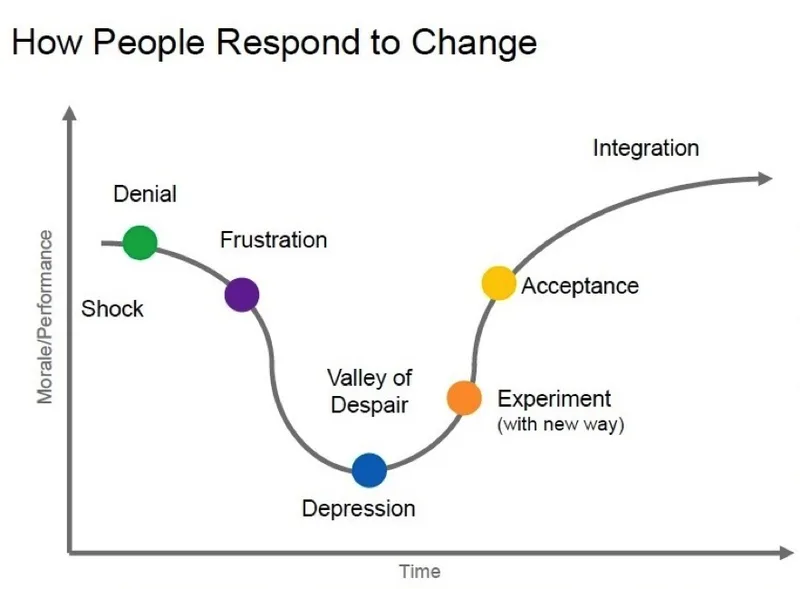
The stages come from Elisabeth Kübler-Ross's 1969 book On Death and Dying, which described how terminally ill patients responded to their diagnosis. Management consultants adapted them to workplace change decades later. The borrowing brought three problems with it.
Where the curve misleads
- It assumes a fixed order. There is no good evidence that people move through set stages in sequence, even in grief. At work, one person goes straight from doubt to using the new system; another slips back into frustration when the next change lands.
- It assumes everyone recovers. The line always ends rising toward integration. In practice some people stay frustrated or leave, and the curve gives you no way to tell them apart from people who are simply slower.
- It turns objections into symptoms. If resistance is a stage, a manager can file a valid objection under "denial" instead of asking whether the person is right.
In a 2017 review in OMEGA, the Journal of Death and Dying, Margaret Stroebe, Henk Schut and Kathrin Boerner found no sound empirical evidence for stage theory and argued that it should be discarded. Their sharpest point carries over to work: expecting people to move through set stages can harm the ones who do not.
Source: Stroebe, Schut and Boerner, OMEGA, Cautioning Health-Care Professionals (2017)
Where the curve helps
None of this makes the curve useless. It makes it a vocabulary rather than a forecast. Its real value is permission: a leadership team that expects performance to dip after a change is less likely to panic when it does. That matters, because a common management error during the dip is to read it as failure and launch another initiative on top.
Why Stability Matters to Performance
Most organizations treat stability as the thing they are moving away from. Ashley Goodall argues in Harvard Business Review that creating stability is just as important as managing change. His point isn't that change is bad. It is that the conditions in which people do their best work are conditions of stability, and organizations take those conditions apart while chasing improvements.
In his words, "People do their best when their environment is predictable, when they have some sense of control, when they are part of a stable set of relationships, when they feel connected to place and ritual, and the point of their efforts is readily apparent to them." That gives five conditions:
- Predictability: knowing roughly what next month will look like
- Control: some say over how the work gets done
- Stable relationships: a team and a manager who stay in place long enough to trust
- Place and ritual: a familiar workplace and the routines that mark the working week
- Clear purpose: seeing the point of the effort
Read the list against a typical restructure and the problem is plain. A reorganization breaks reporting lines, which hits relationships. It changes routines and often desks or offices, which hits place and ritual. It creates uncertainty about roles, which removes predictability and control. Purpose usually survives on paper, and it is the first thing people stop believing.
Goodall, who spent fourteen years at Deloitte and later worked as an executive at Cisco, develops the argument in his 2024 book The Problem with Change. It implies a cost most business cases leave out: a change that erodes stability can leave an organization worse off even when it delivers exactly what it promised.
Source: Ashley Goodall, Harvard Business Review, Creating Stability Is Just as Important as Managing Change
The practical conclusion isn't to change less. It is that the team is the unit worth protecting. A team that has learned to work together carries a large share of an organization's real capability, and that capability doesn't appear on an org chart, which is why reorganizations destroy it so casually.
How Much Change Employees Are Absorbing
Gartner researchers Cian O Morain and Peter Aykens reported in Harvard Business Review that the average employee experienced 10 planned enterprise changes in 2022, up from 2 in 2016. Restructures, culture programs and replacements of old technology systems each arrived with their own justification.
Nobody set out to multiply the change load by five. It happened because every initiative was approved against its own business case and no function owned the total. Ask most executive teams how many changes are landing on a given team right now and they can't answer, which means the load is unmanaged rather than accepted.

Willingness fell over the same period. In a Gartner survey, 74% of employees said they were willing to support organizational change in 2016; by 2022, only 38% did. In Prosci's 2023 study of 2,668 respondents, 80% said their organization was near, at or past the point of change saturation, where more change can no longer be absorbed well.
The fix doesn't need a new framework. It needs one list, kept centrally, of every change currently being asked of each part of the organization, reviewed before anything is added. Organizations that keep this list start sequencing change instead of stacking it, and sequencing is most of the fix.
Running more change than your teams can absorb?
Our Leadership and Organizational Change Management program works with leadership teams on sequencing change, protecting what already works, and leading through the period when performance dips before it recovers. Request a proposal.
Five Ways to Run Change and Stability Together
1. Name the constants
At the start of any significant change, say what will stay the same: which teams stay intact, which routines survive, what the purpose still is. It costs nothing and is rarely done, because leaders are busy explaining the change. People size their anxiety to the unknown, and an unbounded unknown produces unbounded anxiety.
2. Sequence and publish the order
A team can absorb one significant change well or three badly. Publishing the order is a form of stability in itself, because it tells people what they won't have to deal with this quarter.
3. Finish things visibly
Much of what gets called change fatigue comes from unfinished change rather than from volume alone. An initiative that quietly loses momentum teaches everyone that the next one can be waited out too. Declaring a change complete, even partly complete, closes it for the people who lived through it.
4. Protect working teams
Where a structural change can be delivered without breaking up teams that work, do it that way, even at some cost to the neatness of the design. A tidy org chart is cheap; a team that works well together is not.
5. Let the people affected shape the rollout
Gartner calls this "open-source change": involving employees in planning and carrying out a change rather than handing it down to them. Gartner's 2022 research found that organizations working this way can cut the risk of change fatigue by 29 percentage points and raise employees' intent to stay by as much as 19 points. The people doing the work usually know which parts of a plan will not survive the first month.
How the Balance Differs in Kenya
In Kenya, a good deal of change arrives from outside, on someone else's timetable. Consider what Kenyan employers have had to absorb since 2023:
- The housing levy: after the High Court struck down the 2023 version, a new Affordable Housing Act took effect, and employers have deducted 1.5% of gross salary and matched it, remitting to KRA from 19 March 2024. In September 2026 the Court of Appeal upheld the new law, dismissing 42 appeals.
- Pension contributions: NSSF rates have stepped up each February under the NSSF Act's phased schedule. From February 2026, the maximum monthly contribution is KSh 12,960 per employee, split equally between employer and employee.
- Health insurance: in October 2024 the Social Health Authority (SHA) replaced the National Hospital Insurance Fund (NHIF), and payroll deductions moved from NHIF's fixed amounts by income band to 2.75% of gross pay, with no upper limit. A year and a half later, the change was still not settled. In March 2026 the High Court ruled the rollout unconstitutional because it had begun before registration and systems were ready.
- The exchange rate: the shilling traded above KSh 160 to the dollar in January 2024 and at about KSh 129.5 in September 2026, repricing imports, dollar debt and anything bought abroad.
The health change is still producing changes of its own. Since SHA began, hospitals have entered claims into the SHA provider portal as well as their own hospital management information system (HMIS), often typing the same information twice. The Ministry of Health is now moving them onto HMIS platforms that connect to SHA directly. Health Cabinet Secretary Aden Duale called it "not a new system", and after claims spread that SHA was being replaced, the ministry had to clarify that it was not. That clarification is the first of the five practices above in action: say plainly what is not changing, before people fill the gap themselves.
None of these was the employer's choice. A Kenyan organization is rarely choosing between stability and change; it is deciding how much discretionary change to add on top of change it doesn't control. That raises the value of internal stability, because it may be the only predictability on offer to the people doing the work.
A second factor cuts the other way. In organizations across East Africa where deference to seniority is strong, resistance often shows up not as objection but as compliance without adoption: the new process is acknowledged, the training is attended, and the old process carries on. A leadership team that reads the absence of pushback as success tends to find out otherwise months later, and from the results rather than from its people: the error rates, turnaround times or sales figures the change was meant to improve have not moved.
Three Common Change Management Mistakes
The permanent transition
The organization is always mid-change, so there is never a current state. Staff stop improving how things work because they expect it all to be replaced. The tell is that nobody can describe the present operating model without using the word "transitioning".
Blaming resistance
Every difficulty is put down to resistance, which places the problem in the people rather than in the plan. Some resistance is people knowing something the plan has missed. Treat the first serious objection as information before treating it as a barrier, because once it is dismissed, people stop raising the next one.
Using stability as an excuse
The opposite failure is just as real. "Our people need stability" becomes the argument against every necessary change, usually from whoever is most comfortable with the current arrangement. Stability means protecting the conditions in which people work well. It doesn't mean protecting a business model that has stopped working.
Frequently Asked Questions
Do 70% of change initiatives really fail?
No, and the claim has been checked. In a 2011 paper in the Journal of Change Management, Mark Hughes reviewed five widely cited published versions of the figure, from Hammer and Champy in 1993 to McKinsey in 2009, and found no valid and reliable empirical evidence behind any of them. The 70% figure is a popular story, not a measured result. Planning around a failure rate nobody can source makes a weak rollout look normal.
Does change management actually improve project outcomes?
The link is strong. In Prosci's benchmarking research, drawing on more than 10,800 responses from 101 countries, 88% of projects with excellent change management met or exceeded their objectives, against 13% with poor. The ratings are self-reported, so this is a correlation rather than proof. The sharpest drop comes between good and fair, which suggests doing it halfway buys little. Following a structured method also helps: 59% of those who used one rated their change management good or excellent, against 26% who improvised.
Is the Kübler-Ross change curve reliable?
Treat it as a vocabulary, not a forecast. Its stages come from Elisabeth Kübler-Ross's 1969 work with terminally ill patients and were adapted to workplace change by consultants decades later. Applied to work, it misleads in three ways: it assumes a fixed order of stages, which a 2017 review by Stroebe, Schut and Boerner found no sound evidence for; it assumes everyone recovers; and it lets a manager dismiss a valid objection as denial. Its real use is preparing a team to expect a dip in performance without panicking.
Why does stability matter as much as change?
Because the conditions in which people do their best work are conditions of stability, and most change programs take them apart as a side effect. Ashley Goodall's argument in Harvard Business Review names five: a predictable environment, some sense of control, a stable set of relationships, a connection to place and ritual, and a clear purpose. A typical reorganization disturbs nearly all of them, which is why a change can deliver exactly what it promised and still leave the organization worse off.
How much change is too much for one team?
There is no universal number, but the load has grown fast. Gartner research found the average employee experienced 10 planned enterprise changes in 2022, up from 2 in 2016, and in Prosci's 2023 study 80% of respondents said their organization was near, at or past the point of change saturation. The load grew because each initiative was approved on its own business case and no one owned the total. The practical fix is one central list of every change landing on each part of the organization, reviewed before anything new is added.
How do you balance change and stability in practice?
Be as clear about what is not changing as about what is. Name the constants at the start, sequence initiatives and publish the order, finish things visibly, protect working teams over a tidy org chart, and involve the people affected in shaping the rollout, which Gartner found can cut the risk of change fatigue by 29 percentage points. In Kenya this matters more, because levies, pension and health insurance contributions and the exchange rate already change on someone else's timetable.
Conclusion
Organizations that handle change well do more than pick a method. They know what they are asking of each team, they say what isn't changing, and they finish what they start.
Count the changes your organization has asked one team to absorb this year. How many of them has anyone declared finished?
If you are working through this balance now, our Leadership and Organizational Change Management program is built for it. Request a proposal and we will look at what your organization is asking its teams to absorb.