

- Employee engagement is at a five-year low. Only 20% of employees worldwide were engaged at work in 2025, the weakest reading since 2020 (Gallup).
- The decline starts with managers. Manager engagement fell from 31% to 22% in three years, and Gallup attributes most of the overall downturn to it. The engagement gap is a leadership gap.
- Adaptive leaders are facilitators, not fixers. Transactional leaders manage performance, transformational leaders inspire vision, adaptive leaders mobilize the organization to learn and change.
- The core is three moves: diagnose the real problem, regulate the pressure on people, and give the work back. The popular four principles (emotional intelligence, organizational justice, continuous development and character) support those moves.
- Adaptive leadership is a set of learnable practices. Few managers practice it yet: only 15% of employees told LinkedIn a manager had helped them build a career plan in the past six months.
The leaders who thrive through disruption are rarely the ones with the loudest answers. They are the ones who can hold a team together when no one has the answers yet. The years since 2020 have made this visible in ways that are difficult to look away from. Hybrid work has settled in, AI is changing what many jobs involve, and customer expectations shift faster than most strategy documents can keep up. In this environment, the command-and-control playbook that built many great African businesses has quietly stopped working.
The question senior teams across East Africa bring us most often is what to do when no one in the room has a clear answer, and the pressure to project certainty is enormous. Gallup's 2026 State of the Global Workplace report puts global employee engagement at 20%, its lowest level since 2020. What's even more concerning is that engagement among managers dropped from 31% to 22% over the same period, and Gallup attributes most of the overall decline to managers. That fits Gallup's longer-running finding that managers account for at least 70% of the variance in employee engagement across business units. The manager is the place to start, and adaptive leadership gives managers a practical way to lead when the answers are not obvious.
Percentage Engaged at Work Worldwide, 2022 vs 2025
All employees compared with managers. Source: Gallup, State of the Global Workplace 2026
Change over the period: employees down 3 points, managers down 9 points.
Bars show the share of each group classified as engaged, not a share of the total workforce.
The manager slump is not universal. In the organizations Gallup singles out for their management practices, 79% of managers were engaged at work in 2025, nearly four times the global average. Those organizations face the same technology shifts and economic pressure as everyone else. What sets them apart is how deliberately they choose, develop and support the people who lead.
What Is Adaptive Leadership?
Adaptive leadership is a change framework developed by Ronald Heifetz at Harvard, set out with Alexander Grashow and Marty Linsky in The Practice of Adaptive Leadership. It helps leaders mobilize people to tackle tough, complex challenges that don't have a clear technical answer. In practice it means working out what matters most to the organization and what can be let go, then building solutions flexible enough to survive contact with a situation nobody fully predicted.
The core distinction it draws is between two kinds of problem:
- Technical problems have a known solution and an expert who can apply it. A broken server, a tax filing and a supply contract are all technical problems.
- Adaptive challenges require people to change their values, beliefs, or behaviors, which is much harder. Restructuring after a merger, shifting an entire culture toward customer-centricity, and transitioning a family business to professional management are all adaptive challenges. They cannot be solved by authority alone.
Most organizations default to applying technical solutions to adaptive problems. They hire consultants, roll out new software, restructure reporting lines. None of it addresses what actually needs to change: the way people think and behave. That is a big part of why so many change programs stall.
Once a challenge is recognized as adaptive, the framework asks a leader to do three things well. These three moves are the core of the approach, and the rest of this article builds on them:
- Diagnose: step back and work out what kind of problem you are actually facing.
- Regulate distress: keep the pressure high enough that people engage with the hard work, but not so high that they shut down.
- Give the work back: hand the problem to the people who have to change, instead of taking it all on yourself.
Where Heifetz supplies the framework, practitioners have translated it into working habits. Karen Ferris's adaptive leadership model is one of the more useful of these, laying out twelve principles that describe what the approach looks like on an ordinary day rather than in a case study.
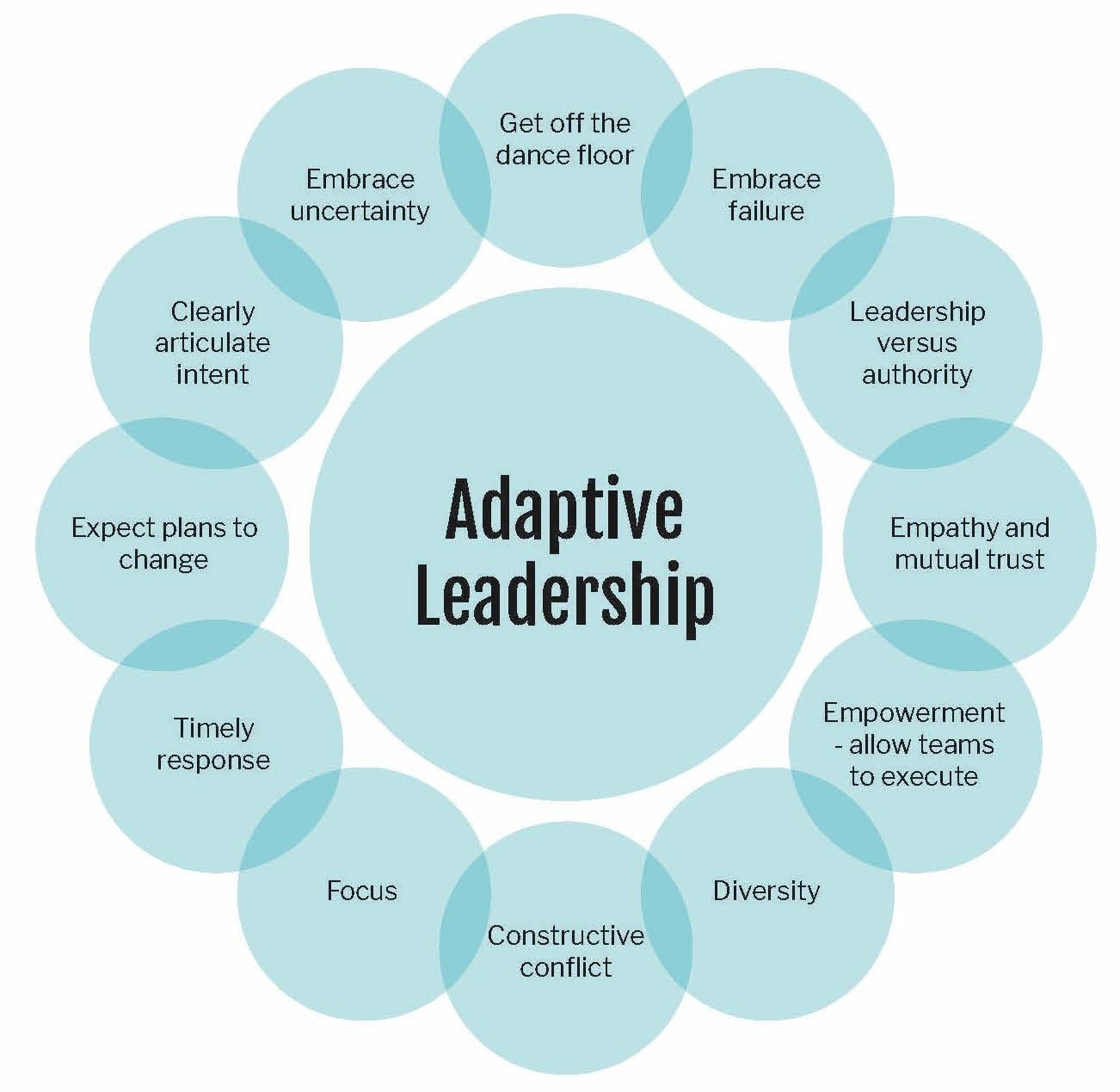
Three of Ferris's principles do most of the work:
- Get off the dance floor: stepping back far enough to see the pattern you are standing inside (an image Ferris borrows from Heifetz and Linsky).
- Expect plans to change: replaces the fiction that a strategy document survives the year.
- Constructive conflict: names the thing most leadership teams quietly avoid.
Notice that none of these are technical skills. They are habits of attention, and they can be built.
Why Adaptive Leadership Matters Now
Four forces make adaptive leadership more useful now than it was a decade ago. Three are global. One is specific to African organizations, and often the hardest to name.
- AI is reshaping work faster than organizations can restructure. The WEF's 2025 Future of Jobs report found that 39% of workers' core skills will need to change by 2030. With 63% of employers in the same survey naming skill gaps as the biggest barrier to business transformation, leaders cannot wait for clarity before acting; they must help teams experiment, learn, and adjust in real time.
- Hybrid and distributed teams have become the norm. You can no longer lead by walking the floor. Trust, accountability, and culture must now travel through screens, which only works when leaders shift from supervising tasks to enabling outcomes. Across East Africa that shift carries a practical edge: teams are spread across locations with genuinely unequal access to reliable bandwidth and current devices, so a leader who assumes everyone is in the same conditions will misread silence as disengagement.
- The talent contract has changed. In Deloitte's 2026 survey of Gen Z and millennials, only 6% named reaching a leadership position as their main career goal. A title no longer holds people on its own. Leaders who help people build skills and see a future in the work keep the best ones. Those who don't are left managing high turnover.
- African organizations face compounded adaptive pressures. Hierarchical cultures that functioned well in stable, growth-phase environments often become a liability when conditions shift. Honest feedback flows poorly when authority gradients are steep. Family business succession puts new professional executives in culturally ambiguous positions where they find themselves technically capable, but poorly equipped to navigate the founder's legacy culture. Pan-African expansion creates cross-cultural leadership demands that no technical solution can answer.
Employers have largely settled on their answer to the skills shift: 85% of those surveyed for the WEF's Future of Jobs Report 2025 plan to upskill their workforce. Much of that work lands on managers running teams in near-constant transition. The leader who can develop people while keeping the work moving now outranks the one who knows the most.
Source: World Economic Forum, The Future of Jobs Report 2025

The Four Principles of Adaptive Leadership
Adaptive leadership is often summarized as four principles. The list is not Heifetz's own; it is a later shorthand that circulates widely. It is still useful, because each principle is what makes one of the three moves work in practice.
1. Emotional intelligence
Adaptive leaders read the room. They notice when a team is anxious, when a meeting has gone quiet for the wrong reasons, and when their own frustration is leaking into a decision. Self-awareness and empathy become diagnostic tools and not just soft skills. This is what makes diagnosis possible.
2. Organizational justice
People do their best work when they believe decisions are fair, even when they disagree with them. Adaptive leaders are transparent about why they decide what they decide, and they create channels for dissent. This is especially critical in African organizational contexts where hierarchy can suppress honest feedback. Fairness is what lets a leader turn up the pressure without losing the room.
3. Continuous development
An adaptive leader is, above all, a learner. They treat their own assumptions as hypotheses, run small experiments, and update their views when evidence demands it. They also invest seriously in the development of their teams through coaching, stretch assignments, and structured leadership development programs. A team that is growing can take the work back.
4. Character
Finally, adaptive leadership rests on integrity. People will follow a leader through uncertainty only when they trust that the leader's word matches their behavior. Character is what makes the other three principles credible.
Adaptive vs Transformational vs Transactional Leadership
These three styles are often confused. Here is how they differ.
| Dimension | Adaptive | Transformational | Transactional |
|---|---|---|---|
| Core idea | Mobilizing people to tackle complex challenges | Inspiring a shared vision | Managing through reward and consequence |
| Leader's role | Diagnostician and facilitator | Visionary and motivator | Manager and enforcer |
| Works best when | The problem requires new behaviors | A culture shift is needed | Tasks are routine and clear |
| Risk if overused | Moving too slowly when urgency is high | Neglecting operational execution | People stop thinking for themselves |
| Example moment | Restructuring after disruption | Launching a new strategy | Quarterly sales targets |
There is no single "best" style here. Mature leaders move fluidly between the three, choosing whichever fits the moment in front of them.
Want to develop adaptive leaders in your organization?
Our Leadership and Organizational Change Management program equips senior teams with the diagnostic, communication, and change-management skills to lead through uncertainty. Request a proposal and we will shape the program around your leadership team.
In LinkedIn's 2025 Workplace Learning Report, 88% of organizations were concerned about retention, and learning opportunities ranked as their top retention strategy. Yet only 15% of employees said a manager had helped them build a career plan in the past six months, down from 20% in 2024. The intent is nearly universal. The managerial habit is not.
How to Develop Adaptive Leadership Skills
Adaptive leadership is a set of learnable practices, not a fixed trait some leaders are born with. The first three practices below build the three core moves. The last two keep them going.
1. Get on the balcony
Heifetz and Linsky call this "getting off the dance floor and going to the balcony" in Leadership on the Line. When you are dancing, you cannot see the pattern of the dance. Adaptive leaders deliberately step back, often weekly, to observe what is actually happening in their organization rather than what they assume is happening, including their own defaults under pressure. From the balcony, ask the diagnostic question: is this a problem expertise can fix, or does it require people to change? Most leaders skip it and treat adaptive challenges as technical ones, which is why so many transformation efforts stall.
2. Regulate the heat
If there is no urgency, people will not do the hard work of changing. If the pressure is too high, they shut down. Adaptive leaders learn to turn the temperature up and down deliberately through what they emphasize in meetings, what they let slide, and what they make non-negotiable.
3. Give the work back
The instinct under pressure is to grab every problem and solve it yourself. This trains your team to wait. Adaptive leaders consciously hand work back: "What do you think we should do?" is the most underused sentence in management.
4. Create structured feedback channels
The most useful information in any organization usually sits with the people closest to the customer, and they are the least likely to be heard in senior meetings. Adaptive leaders build deliberate channels to surface these voices, so change is something the team helps shape rather than something done to it. Clear expectations and structured feedback loops make it possible to flag problems early rather than plaster over them.
5. Embed after-action reviews
Honestly examining what worked, what didn't, and why, without blame, is what separates consistently good leaders from intermittently good ones. It develops through repeated practice and honest feedback, not a single workshop. Most organizations skip this step. The ones that don't learn faster.
Examples of Adaptive Leadership in African Business
The current leadership literature leans heavily on Western and political examples. But some of the most instructive cases of adaptive leadership in recent decades have happened in Africa.
James Mwangi at Equity Bank
When James Mwangi joined Equity Building Society in 1994, it was struggling and facing insolvency, and serving a customer base that traditional banks had written off. Rather than imitate the established banks, Mwangi did something adaptive. He redefined who a "bankable" customer was, building small savings, payment and credit services around the incomes of people the big banks ignored, and turned the institution into a movement around financial inclusion years before it became a licensed commercial bank in 2004. Equity Group is now one of East Africa's largest financial institutions. The strategy was a series of adaptive bets, made under pressure, with ongoing learning.

Strive Masiyiwa at Econet Wireless
Masiyiwa was an engineer at Zimbabwe's state telephone company before he left to start his own business. When he set out to run a private mobile network, he fought the state monopoly in a legal battle that lasted four years. When he finally won, he had to build a business in one of the most volatile economies on earth. His engineering got him into the industry. What kept Econet going was his ability to keep teams motivated through extraordinary uncertainty, and to keep adapting the business model as the operating environment shifted underneath him.
Safaricom and the M-Pesa pivot
M-Pesa began in 2005 as a pilot with the microfinance institution Faulu Kenya, built for loan repayments. During the pilot, customers started using it to send money to each other. Less adaptive leaders would have corrected the customers. Safaricom's leadership read the signal, redesigned the product around what people actually wanted, and in doing so built one of the most widely used payment systems in Kenya. That is diagnosis-then-redesign in textbook form.
The common thread is not the industry or the scale of the challenge. It is the willingness to not pretend to have the answer, and to mobilize the organization to find one.
Three Common Adaptive Leadership Mistakes
Most leaders who try to apply adaptive leadership run into the same three traps.
The expert trap
If you were promoted because you were the best technical person in the room, your instinct will be to keep solving problems yourself. You will burn out. The cure is deliberate restraint and asking questions instead of giving answers, even when you know the answer. Build a peer group, inside or outside your organization, with whom you can think out loud.
The harmony trap
Adaptive work is uncomfortable. If your team meetings are always pleasant, you are probably avoiding the real conversations. Adaptive challenges always surface tension. That's how you know they're adaptive.
The one-off training trap
Sending leaders to a two-day workshop and expecting lasting behavior change. Adaptive capacity builds through repeated real-world practice with structured reflection. Event-based learning has its limits.
Frequently Asked Questions
What is adaptive leadership in simple terms?
It is the practice of leading people through challenges that have no clear answer by diagnosing what is really going on, managing the emotional pressure, and helping the team itself find the way forward.
What are the four principles of adaptive leadership?
Emotional intelligence, organizational justice, development (continuous learning), and character. The list is a popular summary rather than Heifetz's own framework, whose core is diagnosing the real problem, regulating distress and giving the work back. The four principles support those moves by building the trust a leader needs to lead through ambiguity.
How is adaptive leadership different from transformational leadership?
Transformational leadership inspires people toward a shared vision. Adaptive leadership focuses on diagnosing complex problems and helping the organization itself learn. The strongest leaders use both.
Can adaptive leadership skills actually be learned?
Yes. Adaptive leadership is a set of learnable practices, not an innate personality type. Skills like reading group dynamics, facilitating difficult conversations, managing resistance to change, and building psychological safety can all be developed through coaching, action learning, and deliberate practice over time. It is still rare in practice: only 15% of employees in LinkedIn's 2025 research said a manager had helped them build a career plan in the past six months.
What are good African examples of adaptive leadership?
James Mwangi at Equity Bank, Strive Masiyiwa at Econet Wireless, and the Safaricom team behind M-Pesa are widely cited examples of adaptive leadership applied in difficult, uncertain environments.
What is the role of psychological safety in adaptive leadership?
Psychological safety, the belief that you can speak up without being penalized for it, is the foundation adaptive leadership requires. Without it, the honest feedback, early warnings, and experimental thinking that adaptive leaders depend on simply don't reach them. In hierarchical organizational cultures, which are common across East Africa, building psychological safety is itself an adaptive challenge. It means changing the unwritten rules about what is safe to say and to whom. Adaptive leaders create it deliberately by responding to bad news without shooting the messenger, asking questions more than giving answers, and by making it visible when speaking up leads to a better outcome.
Conclusion
If you lead a team in Kenya or anywhere in East Africa right now, you are almost certainly facing at least one major adaptive challenge:
- A generational handover
- A digital transformation
- A culture shift
The technical playbooks will only get you part of the way. The rest depends on whether your senior team can hold steady in uncertainty and bring their people along through the hard parts.
Adaptive leadership is a discipline. And like any discipline, it can be built. A simple exercise to get you started: look at the challenge keeping you up this week. "Is it really a technical problem, or have you been treating an adaptive one as if it were?"
If you are ready to develop adaptive leaders in your organization, our Leadership and Organizational Change Management program is designed for exactly this work. Request a proposal and we will help you map out what you need to thrive in the years ahead, or contact us if you have questions first.