

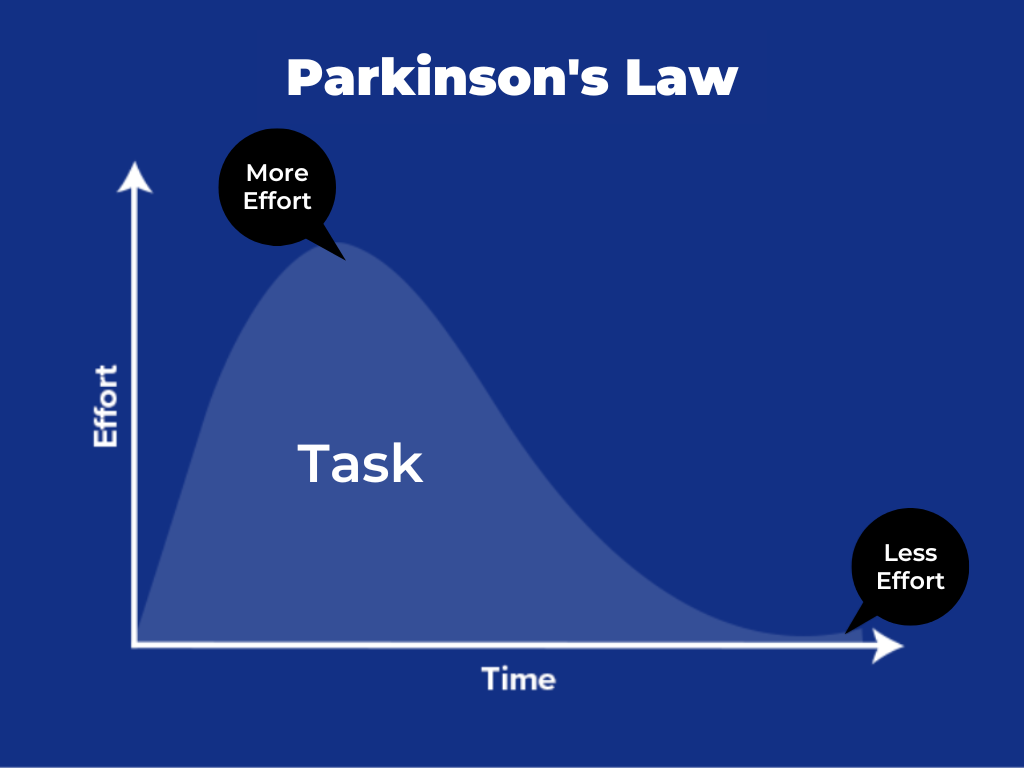
- Parkinson's Law began as satire about bureaucracy, not as time-management advice. Cyril Northcote Parkinson wrote it for The Economist in 1955 to mock government offices that kept hiring whether or not there was more work.
- The best-known evidence for tighter deadlines has collapsed. The 2002 study behind most deadline advice failed to replicate in 2026 and was then retracted over concerns about its data.
- The real problem is constant interruption. Microsoft's 2025 data shows the average worker is interrupted every two minutes, and 57% of meetings are called without a calendar invite.
- Shorter weeks worked when companies cut the work first. In a trial of 2,896 employees across 141 organizations, burnout fell and job satisfaction rose, and every company reorganized its work before shortening the week.
- To get time back, cut the work, not the deadline. A deadline only changes when work gets done. Deciding what not to do changes how much work there is.
Almost every manager has set a two-week deadline for a two-day task and watched the work take all two weeks. The usual diagnosis is Parkinson's Law, and the usual prescription is to give people less time. It is satisfying advice. But it misreads what Parkinson actually wrote, and the best-known study behind it has since been retracted.
In our work with senior leadership teams across East Africa over the past decade, we rarely meet a team with too much time. Far more often, we meet a team whose day is broken into slots too short to finish anything, working to deadlines nobody has explained, in a culture where few people will risk telling a director "that timeline is not achievable." Cutting the time available in that situation does not create focus. It produces a late night and a worse result.
Composition of Workplace Meetings by Type and Timing, 2025
Share of all meetings observed on Microsoft 365. Source: Microsoft Work Trend Index, June 2025
More than half of all meetings, 57%, are called without a calendar invite.
Categories overlap and each bar is a share of all meetings, so the bars do not sum to 100%.
What Parkinson Actually Wrote
Cyril Northcote Parkinson was a naval historian, and the essay that made him famous appeared in The Economist on 19 November 1955. It opens with the line everybody quotes: "Work expands so as to fill the time available for its completion." Then it does something the quoters usually skip, spending most of its length on arithmetic showing that the British Admiralty's shore staff had grown substantially while the number of ships and sailors fell.
The essay's best-known passage is a story. An elderly lady with time on her hands spends an entire day sending a single postcard to her niece: an hour finding the card, another hunting for her spectacles, half an hour searching for the address and twenty minutes deciding whether to take an umbrella on the walk to the postbox. The story was only the warm-up joke. Parkinson's real target was government offices, where he argued that the number of officials keeps rising whether or not there is more work for them to do.
He explained the rise with two rules:
- "An official wants to multiply subordinates, not rivals." An overloaded official would rather hire two juniors than share the work with an equal, because an equal competes for promotion and juniors do not.
- "Officials make work for each other." Once the juniors arrive, they generate drafts, memos and sign-offs that someone has to read and approve.
Everyone ends up busy, but the real workload has not grown. So Parkinson's Law does not say "give people less time and they will work faster." It says organizations create work for themselves, and that points to a different fix. Squeezing each person's calendar will not help much. Cutting the approvals, reports, coordination meetings and status updates the organization has invented for itself will.
Parkinson even supplied a growth rate. Staff in a public administrative department, he wrote, will increase by between 5.17% and 6.56% a year, irrespective of any variation in the amount of work to be done. The precision was part of the joke. The pattern it mocked is still visible on most org charts.
The Evidence Problem With Tighter Deadlines
For more than two decades, the empirical backbone of modern deadline advice was a 2002 paper by Dan Ariely and Klaus Wertenbroch, Procrastination, Deadlines, and Performance.
Its best-known experiment gave students three texts to proofread over three weeks. Each student worked under one of three rules:
- Evenly spaced deadlines, one text due each week, set by the researchers. This group did best: it found the most errors, submitted the fewest days late and earned the most.
- Self-set deadlines, with due dates the students chose for themselves. This group came second.
- One final deadline, with all three texts due at the end. This group came last.
In plain terms, the study suggested that tighter, more frequent deadlines set by someone else get the best work out of people. It became the study behind most of the "break it into checkpoints" advice you have read.
In July 2026, Psychological Science published a replication by Kyle Hyndman and Alberto Bisin, who reran the same proofreading experiment with 124 adults at a large US public university. The original result did not hold up. Whichever deadline rule people worked under made almost no difference to the three things the 2002 study measured: how many errors they found, how many days late they submitted and how much they earned. The evenly spaced deadlines set by the researchers did no better than the alternatives. In September, the journal retracted the original paper altogether.
Psychological Science retracted the 2002 paper on 2 September 2026. The notice said the replication "raised questions about the underlying data in the original study," and that an independent analysis of the original datasets "called into question the veracity of the overall findings." The evidence was thin even before that: the proofreading study ran on 60 students, about 20 per condition.
Source: Retraction notice, Psychological Science (September 2026)
None of this makes deadlines useless. They still give a team a shared point to work toward, and they show people what the organization considers important. What the evidence no longer supports is the idea that adding or tightening deadlines, on its own, makes people more productive. If shorter deadlines are your whole time management strategy, you are relying on a result that has not held up.
If your people hit every deadline you set, every time, the dates probably include more time than the work needs. That is an estimating problem, not a discipline problem, and the fix is better estimates (habit 6 below), not shorter dates.
Where the Working Day Actually Goes
Rather than test deadlines, Microsoft looked at how people actually spend their working day. Its Breaking down the infinite workday report, published in June 2025, combined usage data from Microsoft 365 with a survey of 31,000 workers. The numbers show a working day broken into small pieces.
The average worker is interrupted by a meeting, email or notification every two minutes, and spends much of the day working through a constant flow of email and chat messages. Fifty-seven percent of meetings are ad hoc, called without a calendar invite, which makes more than half the meeting load impossible to plan around. Meetings after 8pm are up 16% year on year. Forty percent of people online at 6am are already triaging email. And PowerPoint edits spike 122% in the final ten minutes before a meeting starts.
That PowerPoint spike is the closest thing to real evidence for Parkinson's Law in the whole report. The work really does get squeezed into the last few minutes. This implies that the slides were always going to be finished in the final ten minutes, whether the meeting was booked for Tuesday or Friday. What got the work done was the meeting itself, not the time leading up to it.

Microsoft's 2025 Work Trend Index found that 48% of employees and 52% of leaders say their work feels chaotic and fragmented, and one in three employees say the pace of work over the past five years has made it impossible to keep up. The problem is not how long people have. It is that they rarely get twenty consecutive minutes of it.
Source: Microsoft WorkLab, Breaking Down the Infinite Workday
What Happened When Companies Shortened the Week
The largest recent test of giving people less time is a four-day week study published in Nature Human Behaviour in 2025 by Wen Fan, Juliet Schor, Orla Kelly and Guolin Gu. It followed 2,896 employees across 141 organizations in Australia, Canada, Ireland, New Zealand, the UK and the US. Each organization cut its working week, in most cases to four days, for six months with no reduction in pay.
The shorter week did not come first. Before the six months began, each company reorganized its work: it cut meetings, shortened the ones that remained, simplified processes and dropped work it did not need. Only then did it take time out of the week.
By the end of the trial, burnout had fallen, job satisfaction had risen, and mental and physical health had improved. The people whose hours fell the most saw the biggest gains. The study's control group, 12 companies that kept their normal working week, showed no such change.
The researchers traced the improvements to three things:
- People felt better able to do their jobs.
- They had fewer sleep problems.
- They were less tired.
The popular version of Parkinson's Law says that if you cut the time, the work will shrink to fit. The trial ran in the opposite order: the companies cut the work first, and the shorter week followed. Cutting the time without cutting the work just pushes the same work into evenings and weekends.
Managers drowning in coordination rather than doing the work?
Our Leadership and Organizational Change Management program works with management teams on delegation, prioritization and the meeting disciplines that give people their day back. Request a proposal.
Seven Productivity Habits That Hold Up
1. Agree the scope before you set a date
A deadline changes when work gets done. Only a decision about scope changes how much work there is. Before you set a date, write down what the work will not include, and share that list with everyone who gets the date. Most missed deadlines are disagreements about scope that nobody raised at the start.
2. Give every deadline a reason
A date with a reason ("the board pack goes to print on the 14th") is something people can plan around and push back on sensibly. A date without a reason looks like a guess, and it teaches your team that dates can move. That costs you when a deadline that truly cannot move comes along.
3. Protect two hours of uninterrupted time
When people are interrupted every two minutes, what they lack is not hours in the week but stretches of time nobody breaks into. Protect two hours a day in which nobody is expected to reply to anything. The manager has to set this up and go first, by visibly not replying during those hours.
4. Cut unplanned meetings, not scheduled ones
Most meeting reviews go after the weekly recurring meeting because it is easy to see. But Microsoft's data shows 57% of meetings are called without a calendar invite, and those are the ones eating the day. You do not need to ban them. Make a written question the default, and call a meeting only when two rounds of writing have not settled it.
5. Record decisions, not minutes
Minutes record what was said. A decision log records what was decided, who owns it and by when. With a decision log, nobody needs a meeting next week to work out what everyone agreed.
6. Compare estimates with reality every month
Once a month, compare how long the team expected its work to take with how long it actually took. Look for patterns, not someone to blame. Over time the team's estimates get more accurate, which fixes deadlines at the source instead of squeezing people to meet them.
7. End the day on purpose
Microsoft found that 29% of workers are back in their inbox by 10pm, so the workday no longer ends on its own. Pick a stopping time, and before you stop, write down tomorrow's first task. A task left half-open overnight keeps taking up attention you will need the next day.
Where personal techniques fit
The same test applies to popular personal techniques. Timeboxing, giving a task a fixed block of time in advance instead of working until it is done, holds up best, because it forces a decision about scope. The Pomodoro technique and the two-minute rule help because they shield people from interruptions, not because they shorten the time available. But all three are tools for individuals. The extra work comes from the organization, and no personal system can fix that alone.
How This Applies in East Africa
Two things make this harder across East Africa than most productivity advice allows for:
- Authority. Where questioning a senior person is uncomfortable, a director's deadline is treated as a fact, not an estimate to test. Unrealistic timelines are rarely raised in advance; they come to light only when they are missed. If you are the senior person, asking "is that realistic?" is not enough. Make it safe to say no, for example by openly accepting a later date at least once.
- WhatsApp. Much of the region's business runs on WhatsApp, which has no working hours, no threads and no way to tell a question from an emergency. It carries interruptions into people's evenings, on their personal phones. Teams that win their time back usually move a whole type of work off WhatsApp, rather than asking people to check it less.
Three Common Productivity Mistakes
The tool trap
Buying a project management platform to fix a prioritization problem. The tool will faithfully display the same overcommitment in a nicer interface, with better colors and a burndown chart showing the exact rate at which your team is failing to deliver what it agreed to. Decide what you are not doing first. Then pick a tool, if you still need one.
The heroics trap
Rewarding the person who saves the project with a weekend. It is understandable, and it teaches the whole team that the way to get recognized is to let something become a crisis. Give the credit instead to the person whose project ran smoothly because it was planned well.
The measurement trap
Tracking activity because it is easy to count. Messages sent, hours logged and meetings attended all rise when a team is struggling, which makes them worse than useless as health indicators. Count things that finished.
Frequently Asked Questions
What is Parkinson's Law?
It is the observation that "work expands so as to fill the time available for its completion," from an essay by the naval historian Cyril Northcote Parkinson, published in The Economist on 19 November 1955. The essay was satire about how organizations grow, not a technique for managing your own time.
What did Parkinson's original 1955 essay argue?
That the number of officials in an organization keeps growing whatever happens to the amount of work. Parkinson showed that the British Admiralty's shore staff had grown while its ships and sailors declined, and explained it with two rules: officials would rather hire juniors than share work with an equal who could become a rival, and once hired, those juniors create work for each other. The famous opening line set up that argument; it was not the argument itself.
Does setting tighter deadlines actually improve productivity?
The evidence is weaker than the advice suggests. The 2002 study by Ariely and Wertenbroch that most deadline advice traces back to failed to replicate when Hyndman and Bisin repeated it in 2026: the deadline rules made almost no difference to how people performed. Psychological Science then retracted the 2002 paper over concerns about its data. Deadlines still give a team a shared point to work toward and show what matters, but shortening them is not, on its own, a reliable way to raise productivity.
What did the four-day week trial find?
A study of 2,896 employees across 141 organizations in six countries, published in Nature Human Behaviour in 2025, found that a shorter week on full pay reduced burnout and improved job satisfaction, mental health and physical health. Twelve comparison companies that kept their normal week showed no such change. The study focused on well-being, not output. The key detail for managers is that the companies cut meetings and simplified their work first, and shortened the week only after that.
How do I protect focus time when the team is interrupted constantly?
Microsoft's 2025 research found that the average worker is interrupted by a meeting, email or notification every two minutes, and that 57% of meetings are called without a calendar invite. What people lack is uninterrupted time, not hours. Protect two hours a day in which nobody is expected to reply, and as the manager, go first by visibly not replying during them.
What is the difference between a decision log and meeting minutes?
Minutes record what was said. A decision log records what was decided, who owns it and by when. With a decision log, nobody needs a follow-up meeting to work out what everyone agreed, which removes one of the ways organizations create work for themselves.
Conclusion
Parkinson's real point was that organizations create work for themselves, whether or not there is more to do. Seventy years on, the memos have become emails and group chats, but the pattern is the one he described. So the manager's job is not to give people less time. It is to cut the work the organization creates: the extra approvals, reports, meetings and messages. That is slower than telling people to work faster, but it is what the evidence supports.
Look back at last week: how many of your team's meetings ended without a decision, and which of them could you cancel this week?
If your managers spend more of their week coordinating than leading, our Leadership and Organizational Change Management program is built to change that. Request a proposal and we will look at where your team's time is going.